


 Home
Home- Learning Centre
- Neutral Drug: Why dilution is required for fed state biorelevant media
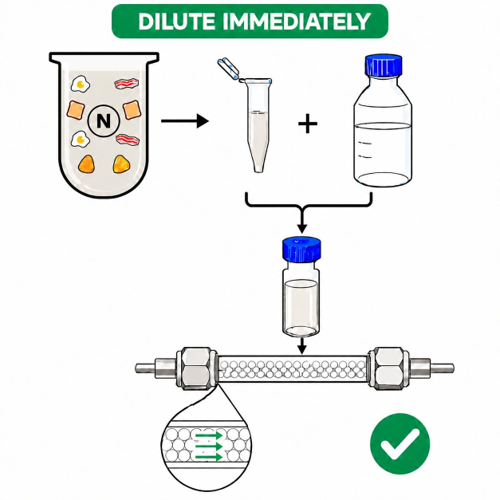
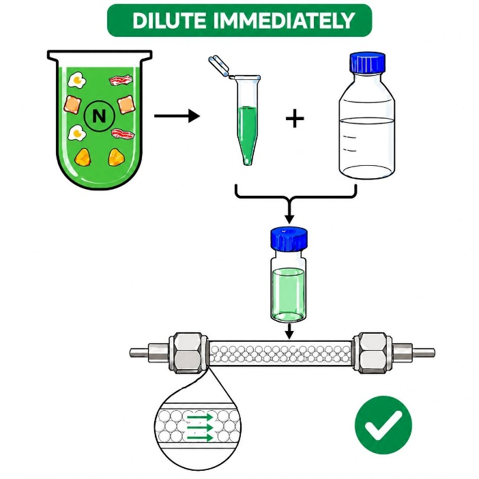
Sample dilution can help prevent a change in chromatographic properties over the duration of analysis, prevent drug precipitation, as well as improve drug stability and minimize drug degradation. Even though drug precipitation risk is typically lower in fed state media compared to fasted media, it is still strongly recommended to dilute samples. Undiluted multiple sample injections (containing fed state media) can adversely affect the chromatographic performance due to build up of the fed state components on the column. Diluting the sample reduce the risk of this and in combination with a built-in gradient, build up can be prevented.
Diluent for neutral drugs in fed state biorelevant media
For neutral drug molecules, methanol and water mixture (ratio 75:25) is generally recommended as the diluent to prepare the standard and dilute the sample. Acetonitrile must be avoided, as it causes phase separation of biorelevant media.
Risk of chromatographic shift
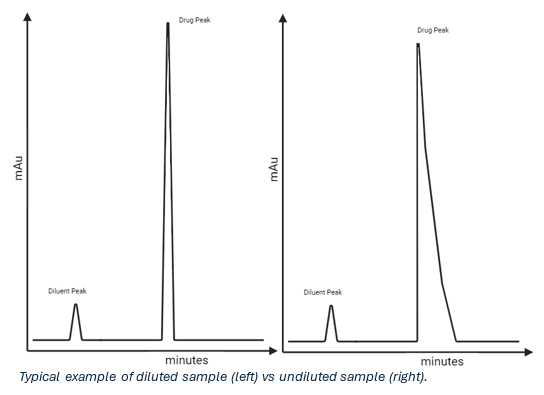
If fed state biorelevant dissolution samples are injected without dilution, there is a significant risk of chromatographic shift in AUC’s. The medium can reduce the power of stationary phase (in case of reverse phase chromatography) by sticking to the silane carbon chains thereby affecting the properties such as change in retention time, peak tailing/fronting and change the elution power. Undiluted sample shortened life of HPLC column and produce arbitrary results.